Why Do Women Own Less Wealth Than Men? Capital, Not Talent


Women do not own less because they have less talent, and not only because they earn less, though in the Netherlands they still do. They own less because capital in a woman's hands goes unseen: by the people who rank it, by the people who fund it, and often by the woman herself. Talent gets counted. Capital does not. In July 2026, Dutch television showed the mechanism in one word.
What happened in July 2026?
On 14 July 2026, on WNL's Goedenavond Nederland, Jort Kelder went down the junior Quote list of young self-made millionaires: models, he said, plus one with een winkeltje, a little shop. Presenter Welmoed Sijtsma called that denigrating. Then the bigger claim: in the whole Quote 500, not one woman had earned her own money. From her father, inherited, or through a husband.
The little shop is My Jewellery, built by Sharon Hilgers. WNL put her estimate that day at 58 million euros, and he was reading last year's list. Quote's 2026 ranking, out in June, already had Hilgers at 65 million, at number 25. Its highest-placed woman was Anniek Schouten, 35, co-founder of Overstory, estimated at 80 million euros. Her company uses satellite imagery to predict which trees will bring down power lines. Not a model. Not a shop.
And the shop, as Hilgers told Lisa van der Velden in FD: close to 100 million euros of revenue, more than sixty stores including Paris, over a thousand employees. She built the company for fourteen years without outside money, and when private equity came in, in 2025, it was on her terms: joint control, and she kept running it.
She answered him herself, one month after giving birth. On Instagram: "Bedoel je mijn winkeltje?" Do you mean my little shop? He never called her, she told FD.
Was he wrong about the numbers?
On income, no: the Dutch figures do not contradict him. According to CBS, 70% of women were economically independent in 2024, against about 83% of men, and the long climb has stalled. Economically independent means a net income of at least 1,295 euros a month in your own name. CBS's Monitor Loonverschillen 2024 puts the hourly pay gap in the business sector at 14.5%, and 6.1% after adjusting for job and education, with part-time work the largest single explanation.
On capital, he was wrong in the way that matters more. He failed to see 58 million euros sitting in front of him. That is not a study-choice problem. It is a recognition problem.
Why does capital in a woman's hands go invisible?
Because the rooms where capital moves were built without her. Research on women founders in Small Business Economics describes an entrepreneurial world male-coded to its bones: deals warmed up over golf, decisions made in rooms women are not in. The women-only networks meant to fix it were dismissed by their own members as knitting circles.

More people who love you. Fewer people who fund you. Which one is in your phone?
When a woman founds a company anyway, the money mostly does not follow her. Paulien Sewuster, answering Kelder in FD, put the sharpest number on it: 99% of growth capital goes to men. It took two women at his own paper, Lisa van der Velden and Paulien Sewuster, to put the facts next to the opinion. Naming women's work is half of what this page argues. So: named.
Money became his scoreboard, and her scenery. The winkeltje is what erasure sounds like when it is said politely, on television, by a man who agrees women should be paid fairly.
What does this look like at home?
Let me go first. I spent two decades inside one of Europe's largest banks, working on a balance sheet of billions. I was good at it.
At home the money was mine, and somehow not mine. I earned it, and it left faster than it came in, on keeping everyone happy. I saw it happen and I allowed it, because I was scared of what would happen if I stopped. For years I called that keeping the peace. It was fear. I managed billions at work. At home I could not say the word no.
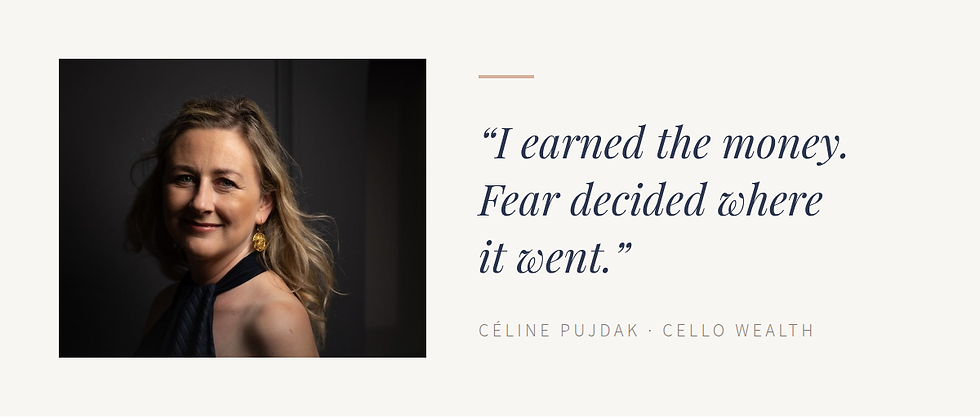
That is the same failure, turned inward. He could not see capital in a woman's hands. Neither could I, and the hands were mine. If you share a household, start with what is actually in your own name: Do You Know What You Own Together?
Do women need to network more like men?
No. The biologist Robert Sapolsky spent thirty-three years studying baboons in Kenya. Males leave their birth troop at adolescence and fight strangers for rank all their lives. A female never leaves. She lives inside a standing web of mothers, sisters, aunts and daughters. She does not build a network. She is born inside one.
When Silk and colleagues measured those bonds directly, in Botswana, females with stronger social bonds had offspring who survived better, whatever the mother's rank. Their paper calls it social capital: a finance term, used literally, in a journal of biology. A 2025 reanalysis of another population did not reproduce the effect, and the argument is live. I do not sell certainty.
The most valuable asset in the system went unmeasured for decades, because the people doing the measuring were counting the fights. A winkeltje, in fur.
My view, not the researchers': women are already running the stronger structure and loading it with the cheaper freight. The bonds are deep, tested, there when someone goes down. I am not asking you to build anything. I am asking you to change what we ship.

What can you put in your network this week?
Something that costs you something to say.
Tell one woman what you earn. Not a range, the number.
If you invest, name what you hold instead of saying "I invest a bit." A name transmits a decision she can copy or reject. Vagueness transmits nothing.
Make one introduction that could end in a client, a contract or a board seat, and say out loud that this is what you intend it to do.
Forward one thing worth reading.
When another woman names a number, answer with yours instead of "well done."
Then your next Money Date: twenty minutes, accounts open, no headlines, one new line on the agenda. Who is the one woman I will say a real number to before the next one?
Two numbers most of us have never said out loud are what our savings really earn and what our pension will pay. Is 3% on Savings a Good Return? and Will You Have Enough When You Retire? give you both.
Frequently asked questions
Q. Is the wealth gap between women and men the same as the pay gap? A. No. The pay gap is about this year's income: 14.5% per hour in the Dutch business sector in 2024, according to CBS. The wealth gap is about what you own: savings, investments, pension, a share of a company or a house in your own name. Income gaps compound into wealth gaps over decades, and recognition gaps keep the capital women do hold out of sight.
Q. What does "een winkeltje" mean? A. Dutch for a little shop. In July 2026 Jort Kelder used the word on WNL television for My Jewellery, the company founded by Sharon Hilgers, with close to 100 million euros of revenue and over a thousand employees according to her FD interview.
Q. Where do I start if I earn well but own little? A. With one real number said out loud to one woman, and a twenty-minute Money Date with your own accounts open. Then your pension overview and your savings rate, in that order.
About the author
Céline Pujdak is the Founder of Cello Wealth. She spent two decades inside one of Europe's largest banks, managing billions. Cello Wealth turns that experience into financial education for women who earn well but do not yet own enough.
Originally shared with Cello Notes readers on 23 August 2026. Get the Sunday letter: Cello Notes on Substack.
Read next: Do You Know What You Own Together?, Is 3% on Savings a Good Return?, Will You Have Enough When You Retire?.
About Cello Wealth
Cello Notes is published by Cello Wealth, founded by Céline Pujdak. Cello Wealth helps women understand their money, build investment portfolios and take control of their long-term wealth.
Educational purposes only. Not financial advice. I don't know your personal situation and cannot advise on it. The company figures and list positions are as reported by WNL, FD and Quote in June and July 2026 and may have changed since. Sapolsky's field account is paraphrased from his own telling, not quoted, and is an observation, not a controlled experiment.
Sources:
Quote, 2026 ranking of young self-made millionaires (June 2026): Hilgers 65 million euros at number 25; Schouten 80 million euros. The 2025 reanalysis is in PNAS, on the Amboseli baboon population.

Comments